
Brazil Coffee Grades Explained: Type, Screen and Cup Class
Brazil grades coffee three ways at once: defects, bean size and cup. Here is how type, screen and terms like Strictly Soft and Rio fit together.
Brazil is the world's largest coffee producer, and Brazilian coffee sits at the heart of countless blends and espressos. Its grading system is also one of the most detailed, combining a defect count, a bean size and a cup classification into one description. Once you know how the three parts fit together, terms like "type 2/3, screen 17/18, strictly soft" stop looking like code. This guide explains the system and what it means for choosing coffee.
The official framework
Brazil's classification of green coffee is set by the Ministry of Agriculture (MAPA). The key regulation is Instrução Normativa No. 8 of 11 June 2003, a technical regulation for the identity and quality of green coffee (café beneficiado grão cru). It classifies coffee by several criteria, of which three matter most to buyers: type, based on defects; screen, based on bean size and shape; and cup (bebida), based on how the coffee tastes. Brazil's federal food supply company, Conab, still refers to this regulation in its coffee purchasing rules.
Type: counting defects
Type is a measure of physical cleanliness. Graders take a 300 gram sample of green coffee and identify defects. Some are intrinsic, such as black, sour, immature or insect-damaged beans; others are extrinsic, such as husks, stones, sticks or clods. Each defect is converted into an equivalent count, and the total places the coffee on a scale of types from 2 to 8, where type 2 is the cleanest.
Technical guides from Brazil's agricultural research bodies give the reference table as follows:
| Type | Defects per 300 g sample |
|---|---|
| 2 | 4 |
| 3 | 12 |
| 4 | 26 |
| 5 | 46 |
| 6 | 86 |
| 7 | 160 |
| 8 | 360 |
Intermediate values give split types such as 2/3 or 4/5, which is why trade descriptions often show two numbers. A lower type number means fewer defects, which generally means a cleaner cup, but type does not measure flavour directly.
Screen: sorting by size and shape
Screen size is measured with perforated sieves whose holes are numbered in 64ths of an inch. A bean retained on screen 17 did not pass through holes 17/64 of an inch across. Brazilian grading separates flat beans (chato) from the rounder peaberries (moca), because they sort differently; flat beans retained on screens 17 to 20 are grouped as large, and screens 15 and 16 as medium. A description such as "17/18" means the lot was sorted to mostly large beans.
Larger, more uniform beans roast more evenly, which is one reason importers specify screen size. But size alone does not decide quality. Our guide to coffee bean screen sizes compares how Brazil, Colombia, Kenya and others use screens, and peaberry vs regular beans explains the moca fraction.
Cup: from Strictly Soft to Rio
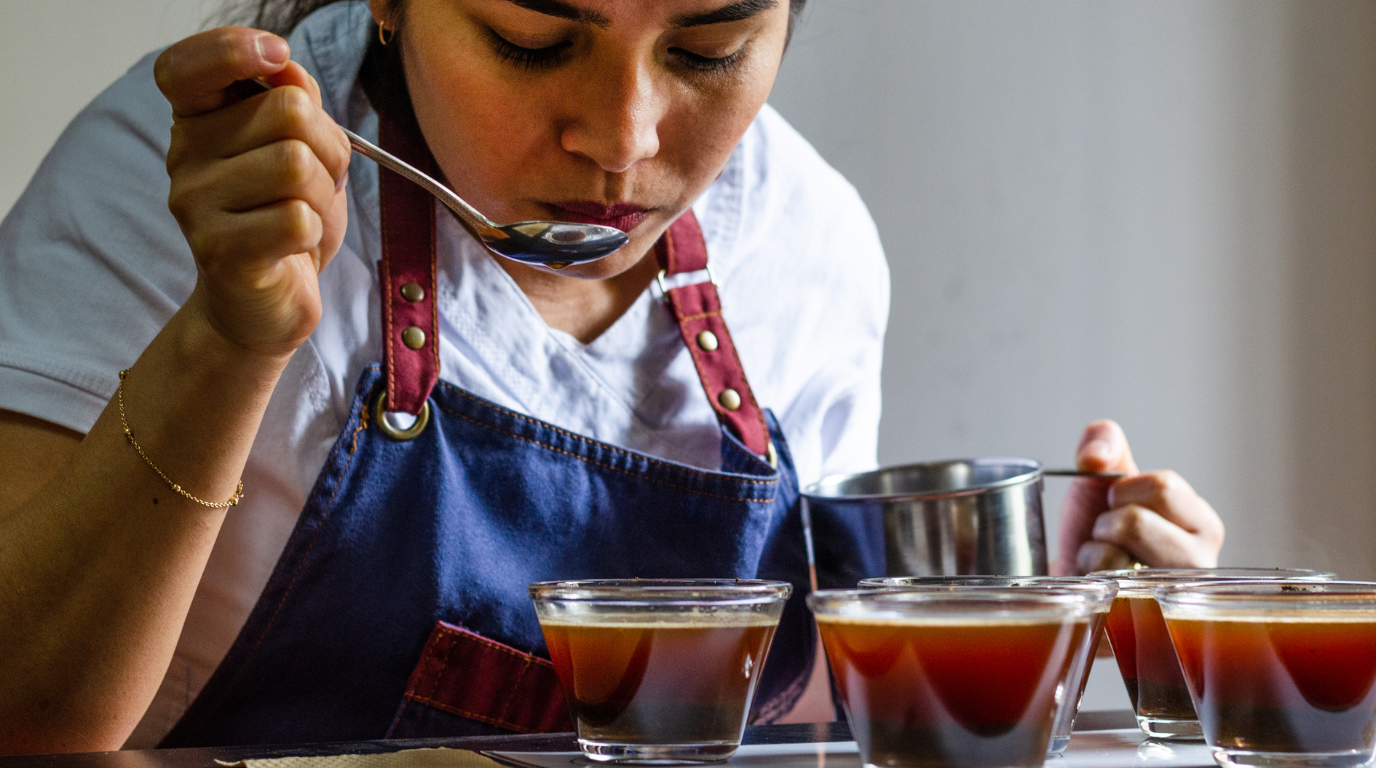
The cup classification is where Brazil's system becomes distinctive. Trained cuppers taste the coffee and place arabica into one of six classes:
- Estritamente Mole (Strictly Soft): all the qualities of Soft, more pronounced.
- Mole (Soft): pleasant, mild and sweet.
- Apenas Mole (Softish): mild, with slightly less sweetness.
- Dura (Hard): a harsher, astringent impression without clear off-flavours.
- Riado (Rioy): a light medicinal or iodine-like taint.
- Rio: a pronounced version of that taint.
Robusta (conilon) coffee has its own, separate cup scale. For a specialty buyer, the top classes are the ones to look for; the Rio end of the scale describes defects most specialty roasters avoid entirely.
How Brazilian grades compare with specialty scores
Brazil's cup classes are a traditional commercial system, built to sort large volumes of coffee for trade. The Specialty Coffee Association's approach is different: a detailed defect count on green coffee plus a scored cupping, with 80 points traditionally marking specialty quality. A Strictly Soft coffee is not automatically an 80-point coffee, and a high-scoring specialty lot will usually be described by its score, farm and process rather than its type and cup class. Our explainer on SCA specialty coffee grading covers the scoring side.
What Brazilian coffee tends to taste like
Brazil grows coffee across a huge range of conditions, and much of it is processed as natural or pulped natural, with the fruit or mucilage left on during drying. That style, combined with many relatively low-acid farms, explains the classic Brazilian profile: nutty, chocolatey, sweet and full-bodied. It is also why Brazil is so often used as the base of espresso blends. Our comparison of washed, natural and honey coffees explains how processing creates that body.
Reading a Brazilian coffee description
- Type 2 or 2/3: very few defects, the cleanest commercial lots.
- Screen 17/18: large flat beans; 16 and below are smaller.
- Strictly Soft or Soft: the best traditional cup classes.
- Natural or pulped natural: expect body and sweetness rather than bright acidity.
- Farm, region and variety: specialty lots often name the farm and a region such as Sul de Minas or Cerrado Mineiro.
If you buy coffee in a shop rather than green from an importer, you will rarely see the full grade. Instead, use origin, process and roast date, as our guide to reading a coffee label explains.
When to choose Brazilian coffee
Choose Brazil when you want a smooth, chocolatey, low-acid cup, for espresso and milk drinks, or as an affordable everyday coffee. If you prefer a cleaner, more delicate, gently bright cup, a washed island coffee such as Jamaica Blue Mountain offers a very different kind of smoothness; our guide to choosing coffee beans for your taste helps you decide, and single origin vs blend coffee explains why Brazil is so common in blends.
Sources
Frequently Asked Questions
What does type 2 mean for Brazilian coffee?
What is Strictly Soft coffee?
What does Rio mean in coffee?
Was this helpful?
Ready to taste it?
Shop 100% authentic Jamaica Blue Mountain Coffee — whole bean, ground and pods.
Shop Coffee


0 Comments
Be the first to share your thoughts.
Leave a comment
Please sign in with your email to leave a comment.